
About the Journal
The African Journal of Customs and Fiscal Studies (AJCFS) serves as a biannual peer-reviewed outlet for
the stimulation of first-rate research on both theoretical and empirical aspects of customs and taxation. The
scope of AJCFS is broadly interpreted to include such areas as policy, law and administration in relation
to customs, regional integration, international trade and taxation at different tiers of government.
The Editorial Board of AJCFS now wishes to invite submissions of original research results from both the
academia and practice in the form of journal papers. A manuscript submitted for consideration by AJCFS
Editorial Board must neither have been published nor be under consideration for publication elsewhere,
either in part or in its entirety.
The Editorial Board is seeking contributions to cover the following themes or related themes:
— Tax administration and compliance
— International taxation and transfer pricing
— Taxation policy and reforms
— Customs modernization and trade facilitation
Secretary
AJCFS Editorial Board
P. O. Box 9321, Dar es Salaam - TANZANIA
ajcfs@tra.go.tz
Current Issue
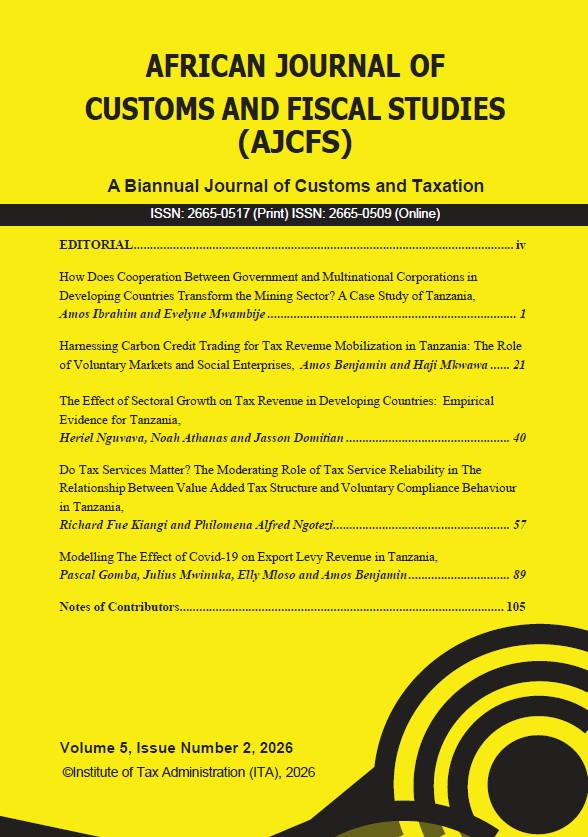
Vol. 5 No. Issue Number 2 (2026): AJCFS
The paper is based on Tanzania’s experience in managing the mining sector. It provides a
qualitative analysis of the importance of cooperation between multinational corporations
and the government in transforming the mining sector’s contribution to the economy.
By highlighting major reforms undertaken by the government in relation to scholars’ comments regarding mining in developing countries. The findings show that the government
of Tanzania amended the income tax act by including specific clauses on taxation of the
mining sector. The new sections have abolished a depreciation allowance of 100 percent
for capital assets, introduced ring-fencing and thin capitalization rules. The paper also
examines the outcomes of renegotiation between the government and one multinational
corporation. The two parties agreed to form a joint venture company where the government
own 16 percent. They also agree on sharing future economic benefit 50/50. These findings
suggest that cooperation between the two parties would yield desired outcomes for the
public.
Published:
2026-07-09
Full Issue

